
Start with the decision you want to improve
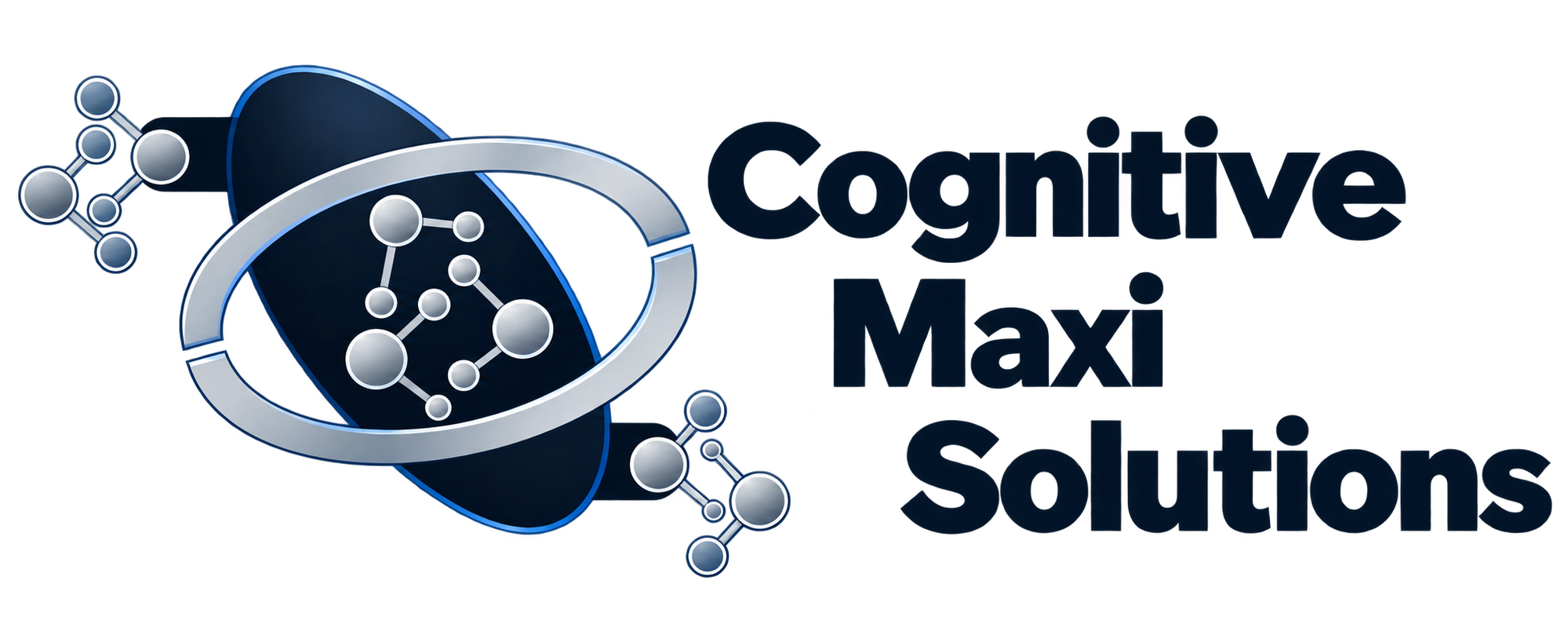
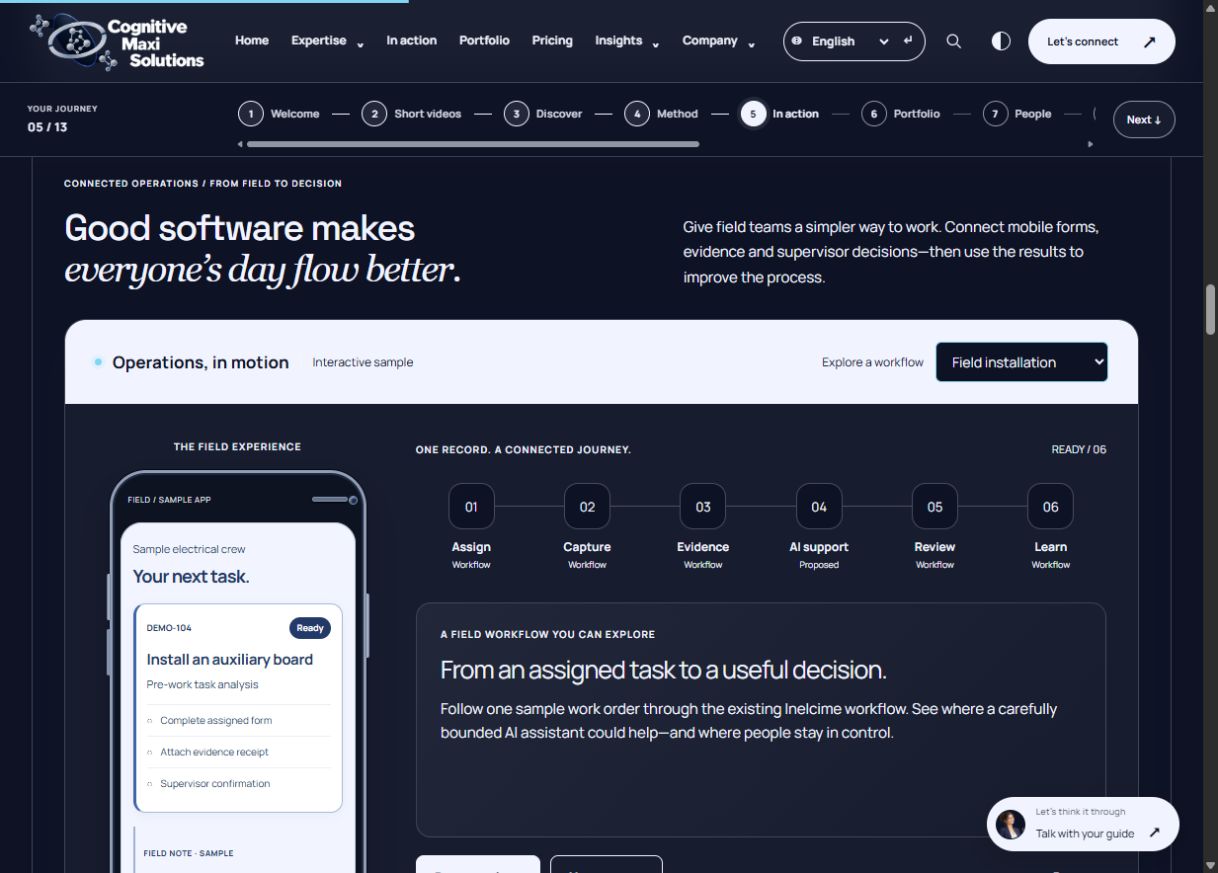
An interesting technology becomes more useful when it has a clear job to do. That principle sits at the center of the new discovery experience on our website. Start by choosing a goal: clarify a decision, connect an AI workflow, test a product or improve delivery. The experience then connects that goal to four working artifacts: a research brief, a cognitive map, an AI contract and pilot evidence. Each stage gives you something concrete to inspect and a different question to consider. These are planning examples rather than a live analysis of your company data, which makes them a useful way to explore possibilities before deciding what information a real engagement would need.
Make the current workflow visible
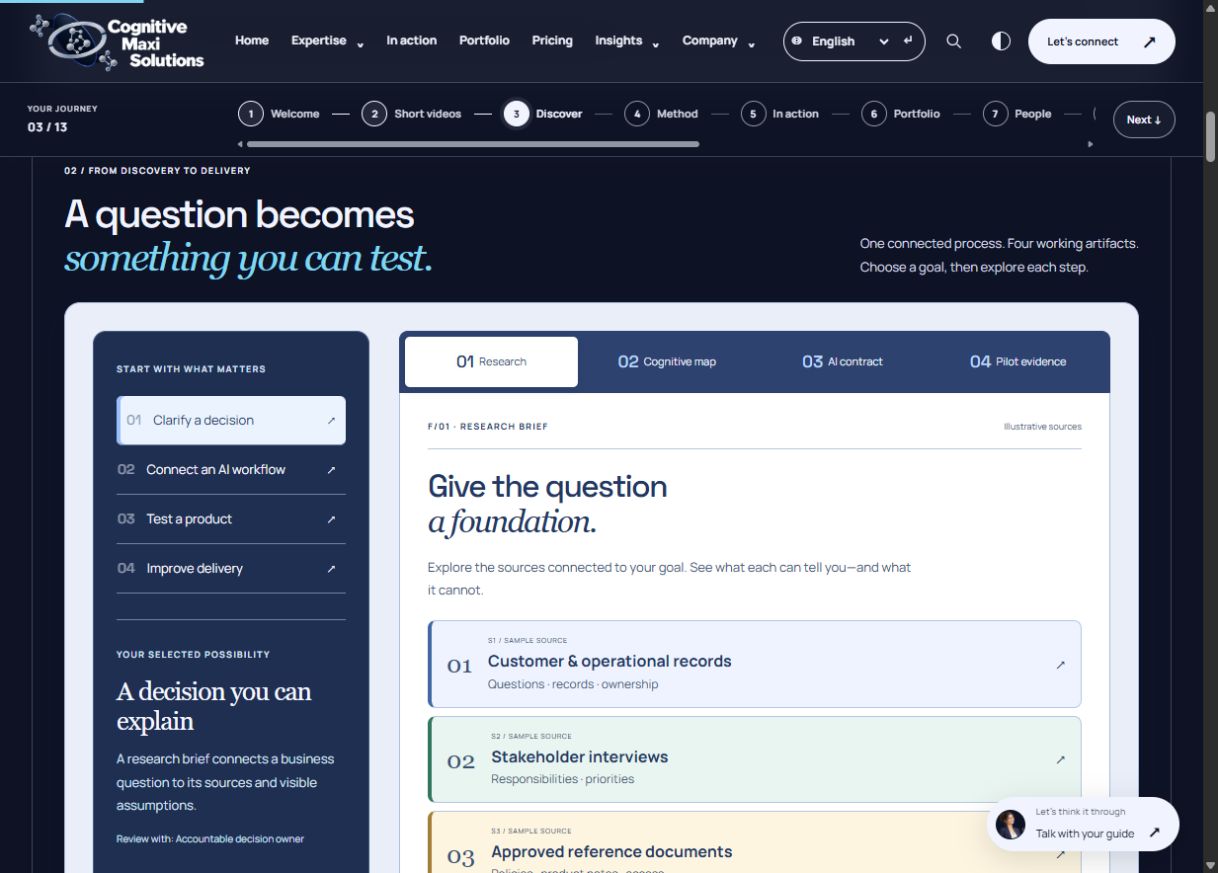
Before a team can improve a process, it needs a shared picture of how work moves today. The new Method section makes that conversation tangible with an interactive BPMN process diagram. Visitors can inspect tasks and decisions, follow the route from an initial business need to a prototype, and see how user testing informs the decision to release or refine the work. A text view provides another way to explore the sequence. The point is to make responsibilities, handoffs and review moments easier to discuss, so a proposed solution is connected to the people who will use it and the evidence that will show whether it helps.
Follow an example from field task to review
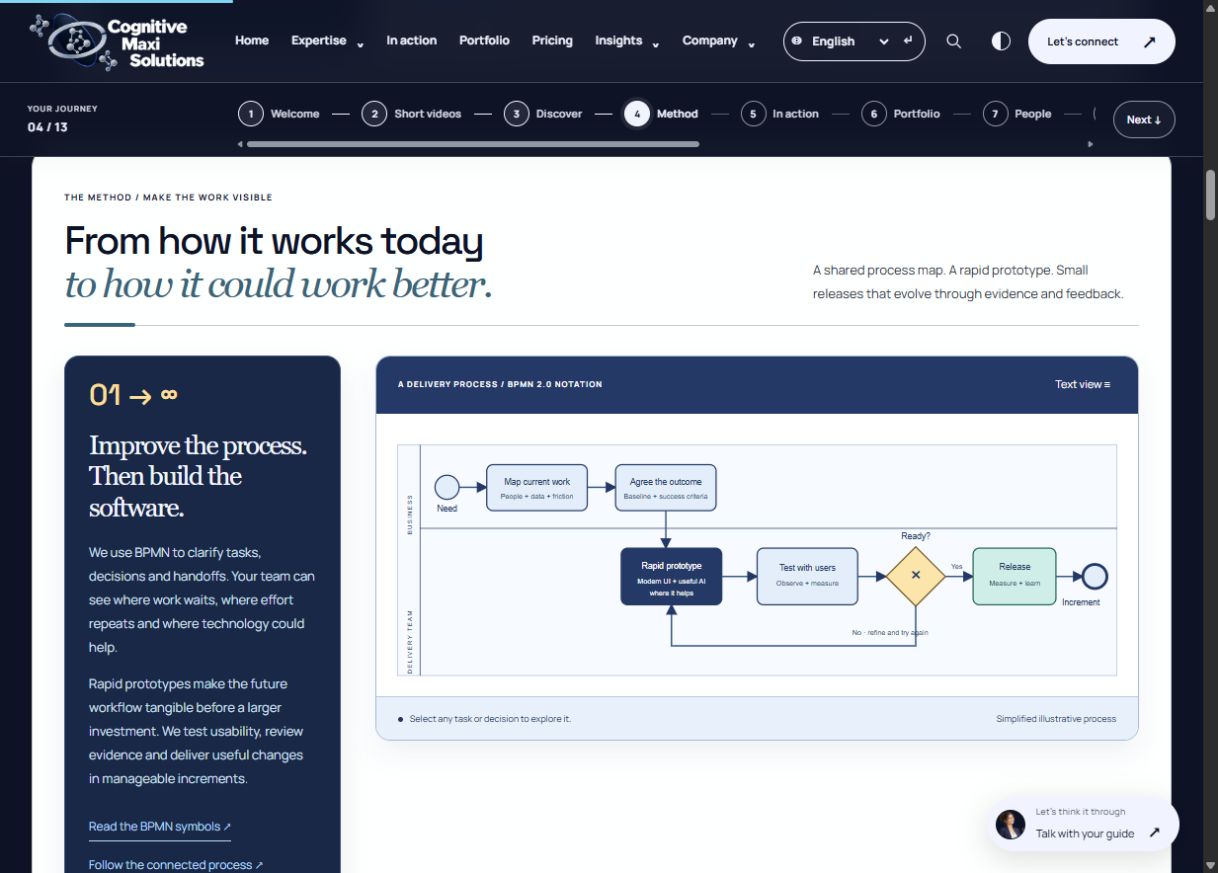
The In action section brings process thinking into an operational setting. You can explore sample scenarios for field installation, personal protective equipment and tools, or vehicle readiness, then follow the connections between assignment, capture, evidence, proposed AI support, review and learning. A sample mobile interface shows how a worker's next task relates to the wider sequence, while progress indicators reveal which demonstration stages have been completed. The distinction between a working sample and a deployed system stays visible: the page does not access your camera, location or device data, and its proposed AI assistance is presented as a possible extension that still needs evaluation.
Treat an estimate as a question to test
The operations experience also includes a simple way to explore a handling-time hypothesis. You can change the current and proposed minutes per task, the weekly task volume and an hourly cost assumption to see how the modeled capacity value changes. This helps make a discussion more specific: which assumption matters most, where does time actually go, and what would a pilot need to measure? The displayed figures are examples calculated from those inputs, not achieved savings, measured business performance or a guarantee. Their practical value is in helping a team define an honest baseline and decide what evidence would justify the next investment.
Carry the useful questions into a project brief
Exploration becomes more valuable when the next conversation retains its context. The project brief offers a place to bring your chosen goal and early thinking together before discussing the work with our team. Use it to identify the decision or workflow you want to improve, the information you expect to need and the questions that remain unresolved. Our service areas provide several possible routes from there, including data research, cognitive mapping, API development with generative AI, rapid prototyping, agile facilitation and pilot testing. Begin with a bounded outcome, involve the people who know the work and use the first test to learn what the next step should be.